
I walked into The Dead Poet’s Society and question the conformity and conservatism of the era, society and institution; by the evening I walked out of Mona Lisa Smile partaking a major subversion of the ideas of the orthodox society. Webbed together with a star cast of Julia Roberts, a star renowned for her awestriking smile and glamour, apart from of course her acting credibility, paired with strong female actors such as Kristen Dunst and Julia Stiles, who best embody their respective strong female voices in the movie Mona Lisa Smile, foregrounding progressive ideologies for the female in a conservative world.
Katherine Watson (Julia Roberts) plays a novel art teacher who left her job in California for a position to teach (or rather radically reform) the most conservative educational institution, Wellesley in the old country, England. With Watson’s advent in Wellesley, she is greeted by the snobbishness in the elitist and conforming girls studying in her art history class. The 1953-54 society as showcased in Mona Lisa Smile portrays the female voice of the patriarchy, in a female character power-packed sensation. The movie progresses with Watson subsequently realizing that Wellesley is less of a school imparting radical formal education, but more a finishing school for girls, whose final project is to get married. Watson proposes her ideologies to her students and helps the girls empower themselves and rise above the shackles of conformity and married life. Through the end of the movie we see a transformation in Betty (Kristen Dunst) who earlier having had played a conforming female of the era, rises above the constructions of an ideal female and ideal wife in order to find true happiness in a society and environment that doesn’t restrict one’s identity and happiness.
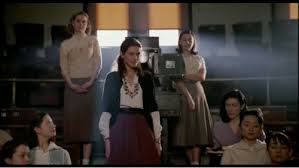
While watching the movie, if I were to infer that the audience of the mainstream media would find the historical representation of an art teacher reaching out to the students to break the core of conformity within them in her philosophical and social manner “entertaining”, thenI would be kidding myself. However, if I were to say that it reaches out to a radical film lover, or a feminist with its portrayal of an individualistic feminist fight and subsequent subversion of conformity and the patriarchy, in the era of 1954, it would be an accurate remark.
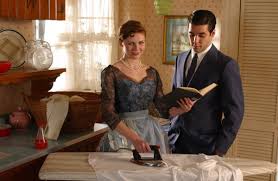
Kristen Dunst plays Betty, a character who embodies the generational product of conformity and conservatism and is highly opposed to subversion. Betty by the end of the movie, breaks through conformity as imposed by her mother and her married life and subverts the image of a model woman constructed by the society.
Mike Newell, in Mona Lisa Smile dexterously recreates the history, society and setting of the conservative old country in 1953-54. Newell is able to grasp the audience in making them experience the feminist spirit embodied by his plot and characters, and finally is able to draw the audience to a state of catharsis by showing them the troubles of the female society before the liberation of women.
 rebelthymachine